Salesforce - Cracking the Enterprise Agentic AI Platform
14 December 2025
A friend of mine runs an online UniFi broadband reseller business. Historically, leads generated online were routed to 35 employees who responded via WhatsApp and closed sales manually. About a year ago, he redesigned the business around an agentic AI architecture, explicitly separating deterministic workflows (rules such as “If…then..else” and routing) from probabilistic reasoning (LLM-driven conversations), with each LLM constrained to a specific knowledge domain.
The results were decisive: a 95% reduction in headcount, faster response times, higher conversion and upsell rates, and materially lower customer acquisition costs. The lesson was clear—AI delivers real productivity only when deterministic logic and probabilistic reasoning are architected separately and governed tightly.
For past 3 years, enterprises attempted to deploy AI and largely failed. The issue was not model quality, but workflow design recognizing the shortcomings of LLM/AI and only uses it to do what it is good at.
Salesforce is the world’s leading cloud-based CRM platform with over 20% global market share, generating predominantly recurring subscription revenue across Sales, Service, Marketing, Data, and Platform clouds. Its competitive moat is built on deep enterprise integration, high switching costs, and a large partner ecosystem. Historically, Salesforce functioned primarily as a system of record and engagement, with growth driven by seat expansion and cross-cloud adoption.
AI Missteps and the Agentforce Reset
Salesforce introduced Agentforce in September 2024, promising low-code, no-code AI automation. Like many enterprise AI initiatives, it underdelivered. It tried to get AI to do and automate everything, resulting in hallucinations, fragile workflows, and user get stuck in “prompt doom loop”. Salesforce was not unique—most enterprise software vendors made the same architectural mistake.
In November 2025, Salesforce fundamentally re-architected its agent platform. The new design clearly separates deterministic workflows (rules, approvals, compliance) from probabilistic AI reasonings, each operating within constrained domains and governed through version control and auditability. This mirrors architectures that have proven effective in my friend’s UniFi reselling business.
This shift enables Salesforce to move beyond CRM into end-to-end enterprise automation—from lead qualification and sales follow-ups to customer service resolution and onboarding. Agentic AI deepens customer lock-in, expands Salesforce’s addressable market, and positions the platform as a system of action, not just a system of record.
The new Agenforce platform is so effective that Salesforce has cut 4000 customers support roles.
Data Readiness as the Real Bottleneck
We agree with management’s assessment that Agentforce has the potential to triple Salesforce’s total addressable market. However, realising this opportunity requires customer data infrastructure to be AI-ready. Enterprise AI adoption is fundamentally constrained by fragmented, ungoverned, and poorly integrated data environments. Salesforce is uniquely positioned to address this bottleneck. Tools such as Data Cloud (Data360), MuleSoft, and Informatica enable customers to centralise, clean, govern, and connect disparate data across cloud and on-premise systems. These platforms form the prerequisite data layer upon which agentic workflows can operate reliably.
We are beginning to see early customer adoption of Agentforce, with meaningful initial revenue contribution (over USD0.5bn revenue run ratem, up 330% yoy). However, not all of Salesforce’s ~200,000 enterprise customers have data architectures ready for agentic AI deployment. It is likely to take several years for a significant portion of the installed base to modernise their data stacks, implying a multi-year adoption and monetisation curve, rather than an immediate step-function uplift.
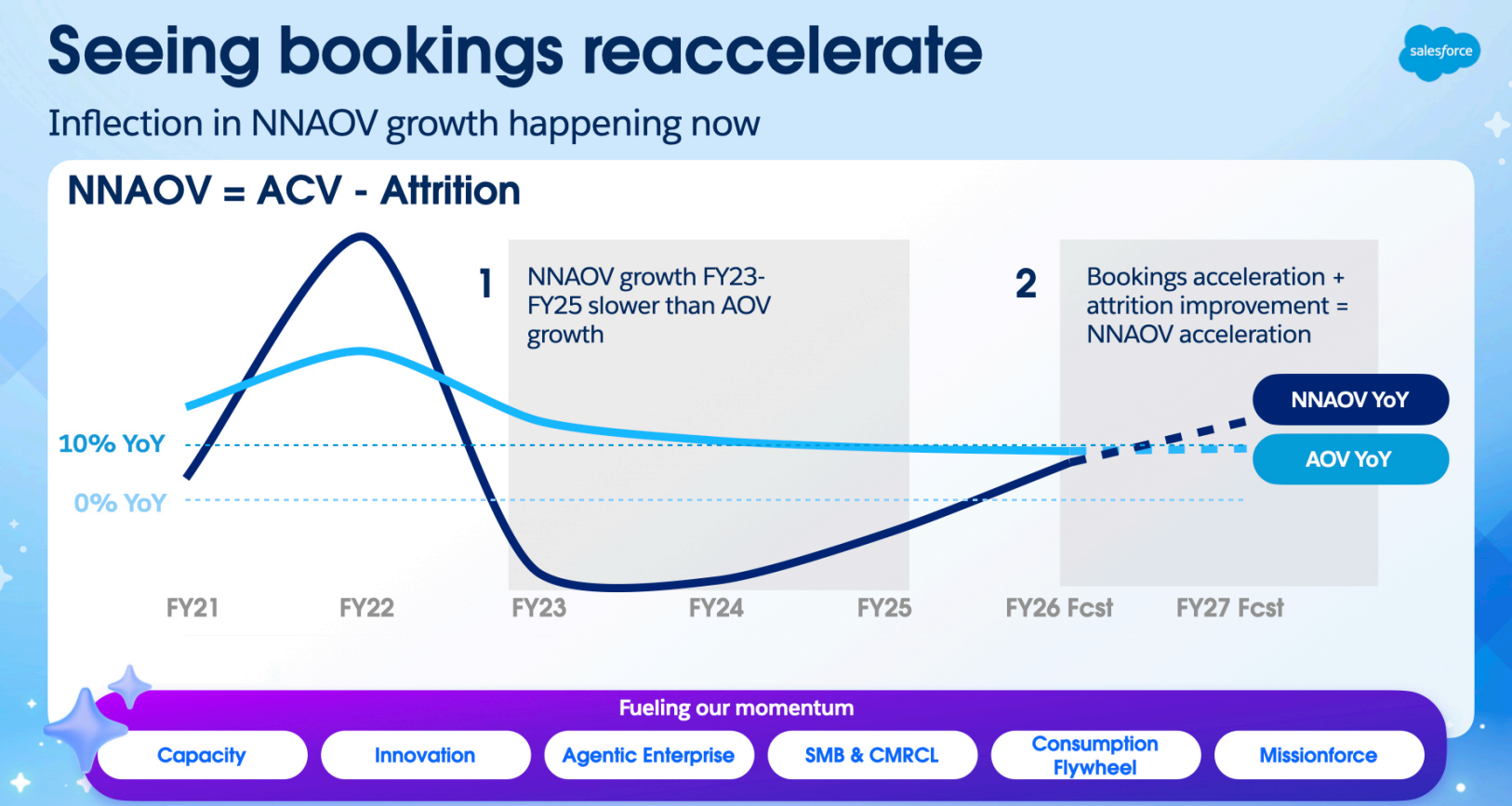
Salesforce’s average order value (AOV) growth has decelerated since 2022, leading the market to increasingly view the company as a mature enterprise software vendor. Management is now observing a recovery in net new AOV (NNAOV) growth and expects this to support a re-acceleration in overall AOV over time. We believe the market has yet to fully appreciate the significance of Salesforce’s recent breakthrough in agentic AI architecture and its potential impact on future growth.
Notes and Disclaimers
This essay and the information contained herein is not a specific offer of products or services. Information on this essay is not an offer to buy or sell, or a solicitation of any offer to buy or sell the securities mentioned herein.
Oaklands Path may be long or short the securities mentioned herein and has no duty or obligation to disclose or update our action on these securities.
This essay contains information and views as of the date indicated and such information and views are subject to change without notice. We have no duty or obligation to update the information contained herein. Further, we make no representation, and it should not be assumed, that past investment performance is an indication of future results. Moreover, wherever there is the potential for profit there is also the possibility of loss.
Certain information contained herein concerning economic trends and performance is based on or derived from information provided by independent third-party sources. Although we obtain information contained in our newsletter from sources we believe to be reliable, we cannot guarantee its accuracy. Moreover, independent third-party sources cited in these materials are not making any representations or warranties regarding any information attributed to them and shall have no liability in connection with the use of such information in these materials.