Observations on AI, software, DC, Employment & Power Capex
10 September 2026
(This article is not written by AI)
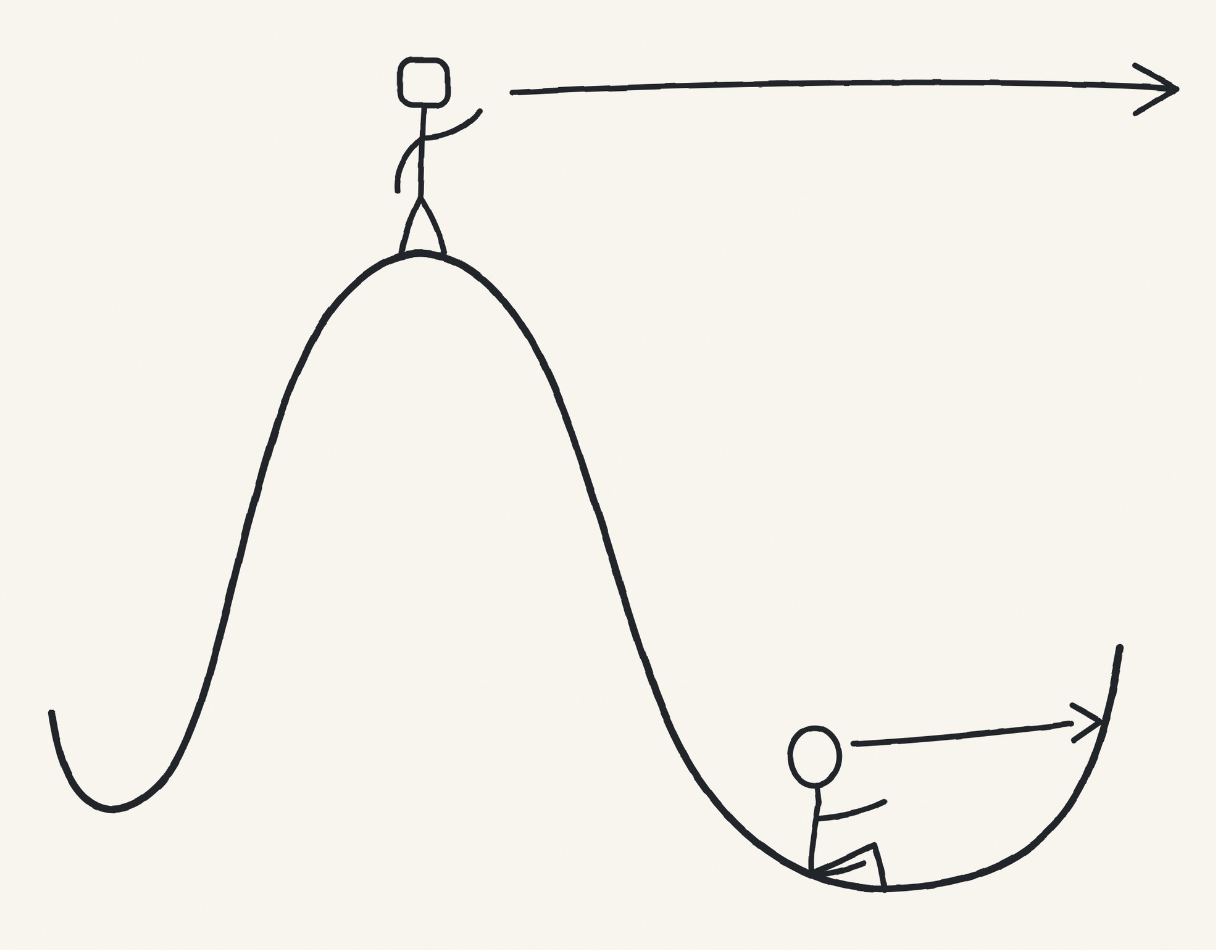
(Thanks Bernard for contributing this idea of stickman cycle)
At the peak of a cycle, market participants feel empowered by their recent success and can see far into the future. Valuations go up to price in a lengthening period of stronger growth.
At the bottom of the cycle, market participants can only see a wall one to two months ahead, and pessimism-filled commentary challenges anyone who dares to think otherwise.
I am not trying to call the peak of the cycle, but I have begun to hear comments such as “just buy this semiconductor stock, it’s guaranteed to grow 30-40% p.a. for the next 5 to 10 years.”
Investing is inherently hard and investors should approach the market with humility.
The SOX Index below has surged with a ferocity rarely seen outside the Dot-com era. But are the similarities truly meaningful, or are we simply overfitting today’s market to a historical pattern?
SOX index (PHLX Semiconductor Sector Index)
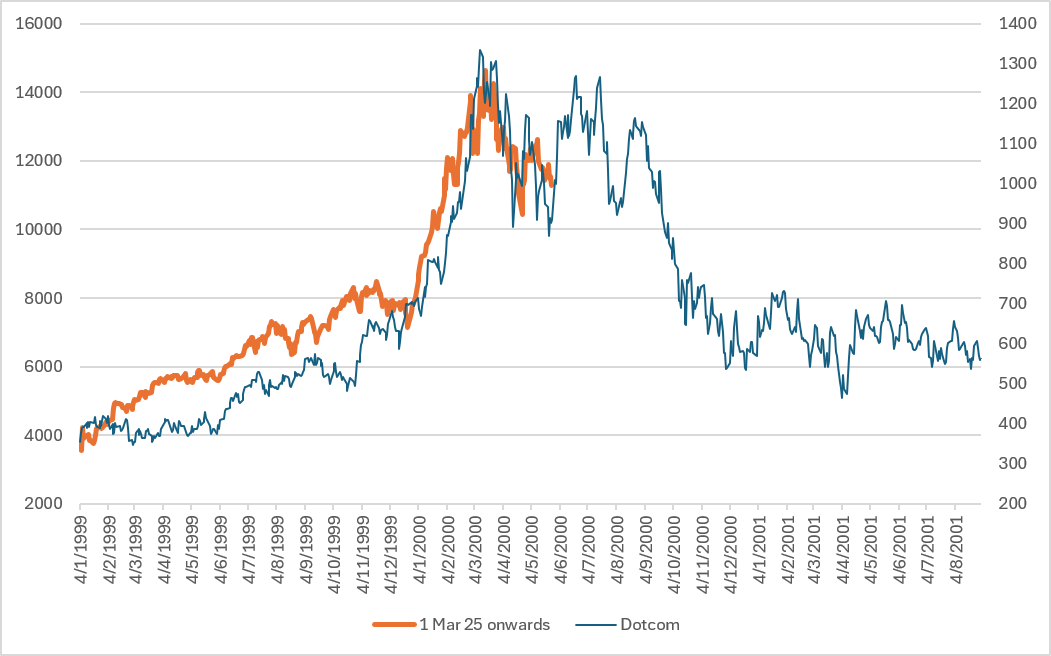 source: Bloomberg
Now let’s look at the hottest sector of the century: Artificial Intelligence.
The introduction of ChatGPT shocked the world with its ability to converse in human language in late 2022. But the hallucination rate was high and it was highly unreliable. The arrival of mature AI harnesses from companies such as Anthropic enabled automated AI agents in the second half of 2025. This marks the beginning of a new wave of AI usage surge and applications introduction. A harness is essentially the deterministic software and infrastructure wrapped around a model to make it do what it is supposed to do and greatly reduce hallucinations. For thousands of years, humans have used harnesses to tame wild horses.
The AI era can be broken down into roughly two distinct periods. The first ran from ChatGPT’s release in Nov 2022 to June 2025, a period when AI had serious hallucination issues and was not so “intelligent”. The second period started from July 2025 when mature harnesses such as Claude Code were launched; suddenly agentic action became a reality, and hallucination rates fell.
Let’s dive into its implications in real life:
1. Customer service agent
Last year, I wrote about a friend who runs an online Unifi reselling business, he buys ads online and gets his 40 staff to reply to WhatsApp messages to sell Unifi Broadband subscription plans. By early last year he managed to build an end-to-end agentic workflow, separating the deterministic software portions from the probabilistic ones. The result is that his company is now left with 2 staff — himself and his wife (I guess cutting his wife’s salary is not an option even in an agentic world). Sales went up 30-40%, customer acquisition cost went down due to better signals captured and fed back into Meta/Google algorithms, upsell penetration improved and profit surged. This friend is now doing a new startup called Jawab.my providing such services to other companies.
2. Agentic marketing agency
Many businesses that I spoke to would often hire a marketing agency to manage things such as (i) SEO, (ii) ads purchases, (iii) ads creation, (iv) website landing page creation and maintenance, (v) optimization of Return on Ad Spend (RoAS) and (vi) brand story and video creation. An ex-housemate of mine is coming up with an Agentic marketing solution to solve the first five use cases in one go with minimal human involvement and better RoAS performance. The AI is way better than the average human at identifying pain points, mass-creating ads and testing them in the real world to select the most effective ones.
3. AI and software
3.1 SaaSpocalypse
This term has dominated the software companies scene for more than a year. Prior to the recent rebound in overall software stock prices after Salesforce announced its 2Q26 result, these companies’ share prices had dropped by 50-75% on average. We bought into companies including Salesforce, SPS Commerce, MongoDB, Elastic, Roper and Constellation Software after the collapse. As every crisis presents both risks and opportunities, we are approaching it cautiously while things are still evolving.
3.2 Coding/ Software Engineering
This point is linked to the SaaSpolcalyspe and is worth a deeper dive to expound its significance. In the past, coding was hard and out of reach for much of the population. You could have an idea of an app to create and which workflow to automate, but you might not have the coding skills or the programmer to execute it. It turns out that large language model (LLM) with harness is great at coding if the user is able to provide clear specifications of what they want. It should be noted that AI remains weak at judgment and architectural reasoning, hence experienced programmers are still needed, but the output is sufficient for many workflow automations and apps. It collapses the cost of producing code, which shifts the bottleneck onto specification and review. That’s a real productivity gain if you’re competent enough to review the output, and a liability if you aren’t.
3.3 Impact on vertical management software (VMS)
AI has empowered thoughtful owners in particular industries to build their own VMS best suited to their businesses. The owner of a B2B laundry service whom I know personally has built a full-suite laundry management ERP with the help of only one senior engineer. He is a mechanical engineer himself and an experienced businessman in the laundry industry, the key thing he does is spec out the requirements clearly, and this system is now helping him to run day to day operations, CRM, drivers management, routes planning and optimization, machine downtime optimization, and so on. He shares that just a year ago it was unthinkable that they could build such an ERP at this cost and speed. Given his depth of understanding and judgment involved, perhaps no one could build a better system than him.
VMS is a very broad space, essentially every single industry needs its own VMS. It thrives in an environment where there are thousands of small players in an industry, for example, car workshop, where numerous small customers need a vendor to provide the software to run their businesses at low cost. And they probably have neither the time nor the skills to craft their own system even with AI. For VMS to have a future, it must build new automated workflow which only becomes possible thanks to AI and integrate it into the existing workflow of the business. For example, with a car workshop VMS, the workshop owner can now just take a picture of a customer’s vehicle, the AI will show the model and recognize the car plate. He then only needs to tell the AI verbally via WhatsApp to issue invoices and bill for the change of engine oil plus labour charges.
Given the much-lowered marginal cost of coding, VMS vendors are able to speed up feature enhancements and expansion into adjacencies. No doubt it would also raise competition, but in a VMS business, coding is perhaps just 20-30% of the business. The business is inherently sticky, the other 70-80% are management, distribution, sales and marketing, customer support, and product insights.
VMS companies that serve a few large customers with not-too-complex workflows are more exposed to disruption. There are also many VMS and general software like SPS commerce which is used by multiple parties (ie, suppliers, customers, regulators, warehousing and transportation providers) which is essentially a network and cannot be replaced. Constellation Software is an accumulator of various types of VMS, it has acquired over 1,100 vertical market software companies since 1995. Within its portfolio, while some will no doubt be disrupted, I think the portfolio will prove to be far stickier than the market is assuming right now. We will delve deeper in a later section into the portfolio management system that I vibe-coded.
3.4 AI and workflow automation and employment
One of our long-time investors began to experiment with using Claude Code for automation in their company after some prodding. They managed to auto-compile medical claims from hundreds of workers, identify suspicious activities, reduce bank reconciliation time from days to a few minutes, and replace a worker who spent all day just optimizing container loadings. This is not an isolated observation; I have seen the same in many other businesses that I prodded to try. When efficiency greatly improves within HR, admin, finance and operations, low-level white-collar jobs begin to lose relevance. Another major area is the accounting profession, from the capturing of invoices data, the double entry, to the matching against payments and bank reconciliation, a large chunk of manual work could be automated as well.
3.5 Autonomous driving and employment
For those who follow the development of autonomous driving, there was a prolonged period when the industry appeared to be stuck at Level 2 (L2). In simplified terms, L3 means “hands off,” L4 means “eyes off,” and L5 means “mind off.” Historically, moving beyond L2 was challenging because higher levels of autonomy were generally thought to require expensive LiDAR systems and millimetre-wave (mmWave) radar sensors. The cost and complexity of these additional sensors became a key bottleneck to mass-market adoption.
However, advances in Vision-Language-Action (VLA) AI models over the past few years have opened up the possibility of achieving higher levels of autonomy using primarily camera-based vision, potentially reducing the need for expensive LiDAR and other sensors. This could represent a significant shift in the autonomous-driving industry. XPeng, for example, claims that its latest autonomous-driving system can achieve L3-level capability using a camera-based approach without relying on LiDAR.
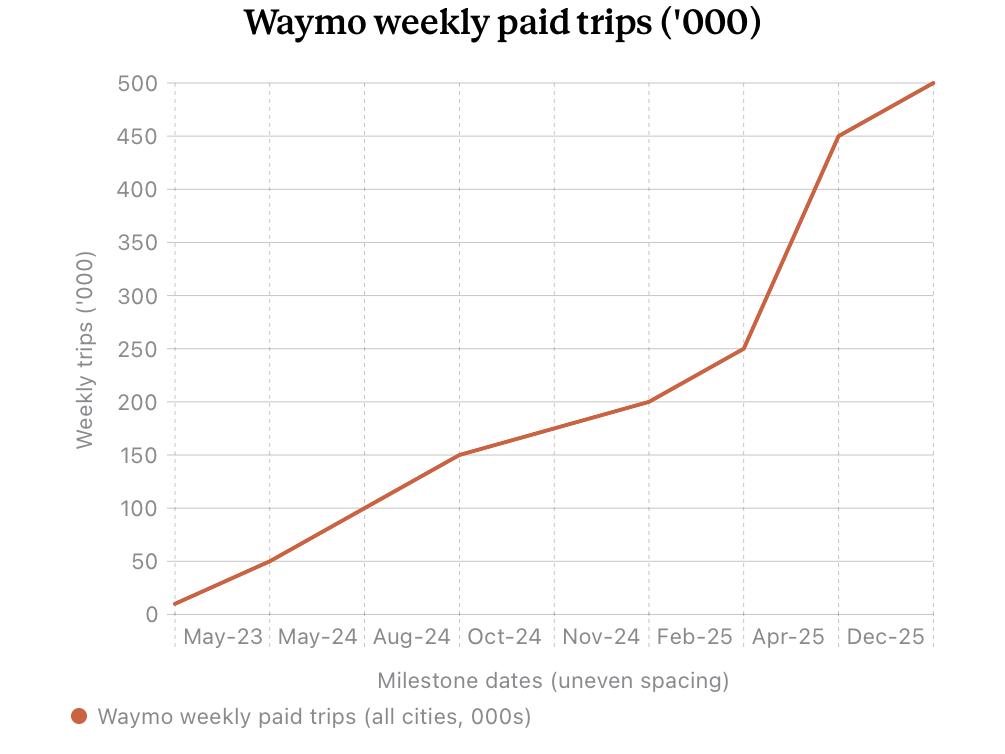 Source: Waymo public statements.
This chart shows Waymo’s autonomous trips completed per week, it has crossed 500k trips per week and is aiming for 1m trips per week by end-2026. Based on estimates, there are 600k-900k full-time ride hailing drivers in the U.S. As for China, this number is 7.5 million. The level of employment in this sector is now more of a regulatory and social issue than a technological one.
3.6 Impact on Enterprise grade software
The unique selling point of enterprise software is sales. The salesperson needs to properly entertain and convince the CEO of a company — who may or may not understand the software — to buy it. When things go wrong, there is a neck to choke. So long as enterprise software companies continue to integrate the right AI features into their products, most of them are safe.
4. AI adoption rate
AI spending is surging, and as we can see from the above observations, AI is attacking both white-collar and some blue-collar jobs together. The rate of unemployment is essentially linked to the adoption rate and the maturity of AI skills.
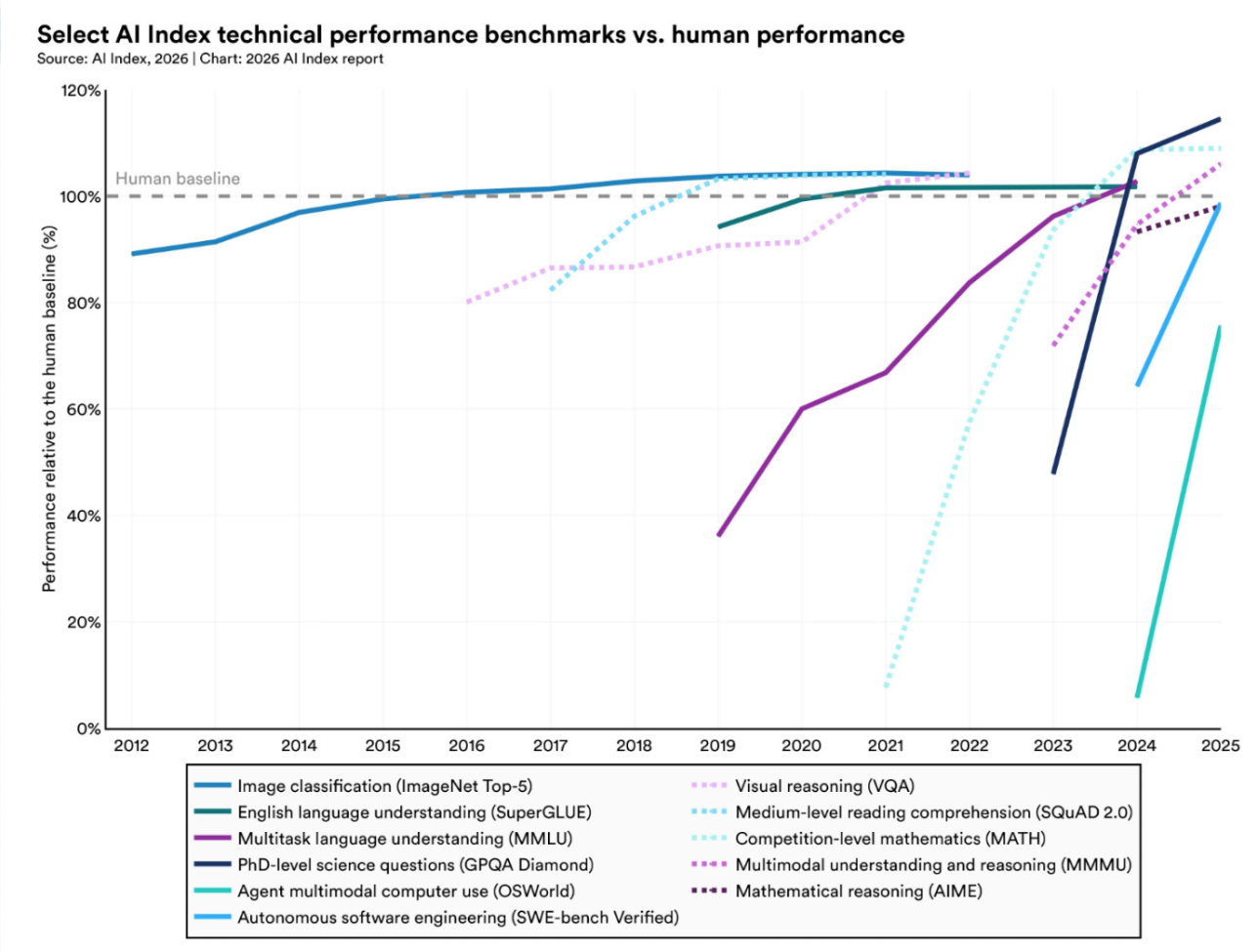 Source: The 2026 AI index Report by Stanford University.
A growing number of models now meet or surpass human baselines in many areas of reasoning, science questions and competition mathematics. However, it may be surprising to some that AI is still not good at design — by design I mean the entire flow that delivers the user experience, i.e. the ability to judge why the button should be here instead of there, what to remove to reduce complexity, and so on.
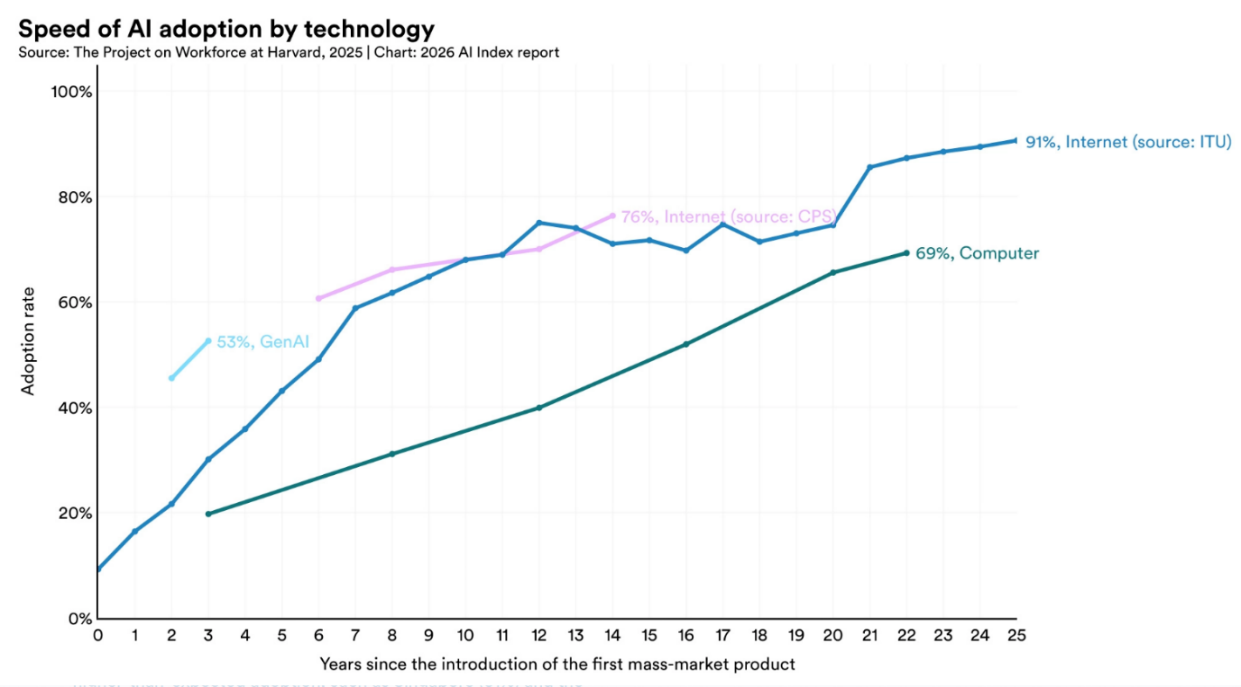 Source: The 2026 AI index Report by Stanford University.
Generative AI has reached 53% population adoption within three years, faster than the PC or the internet, though the pace varies by country and correlates strongly with GDP per capita.
4.1 The counter-intuitive fact about jobs
It is not all doom and gloom, the market narrative thus far solely focuses on the destruction of jobs, especially software developer jobs. However, SignalFire’s data shows that software engineering headcount is growing faster than most other job functions in tech.
AI-fluent developers are experiencing a renaissance. Software development job postings on Indeed increased 14% year-over-year in April 2026, and more than 47% of those postings now mention AI, suggesting the growth is concentrated in roles that require working alongside the technology rather than competing with it.
Still, my current observation is that AI is likely to eliminate more jobs than it creates, though skilled engineers are safe. It has led to a change in job requirements. It may even increase employment in certain areas, such as forward-deployed engineers (FDE) as well as vibe-coding rescue engineers, whose role is to fix and refactor the mess caused by AI coding.
4.2 AI spend by US corporations
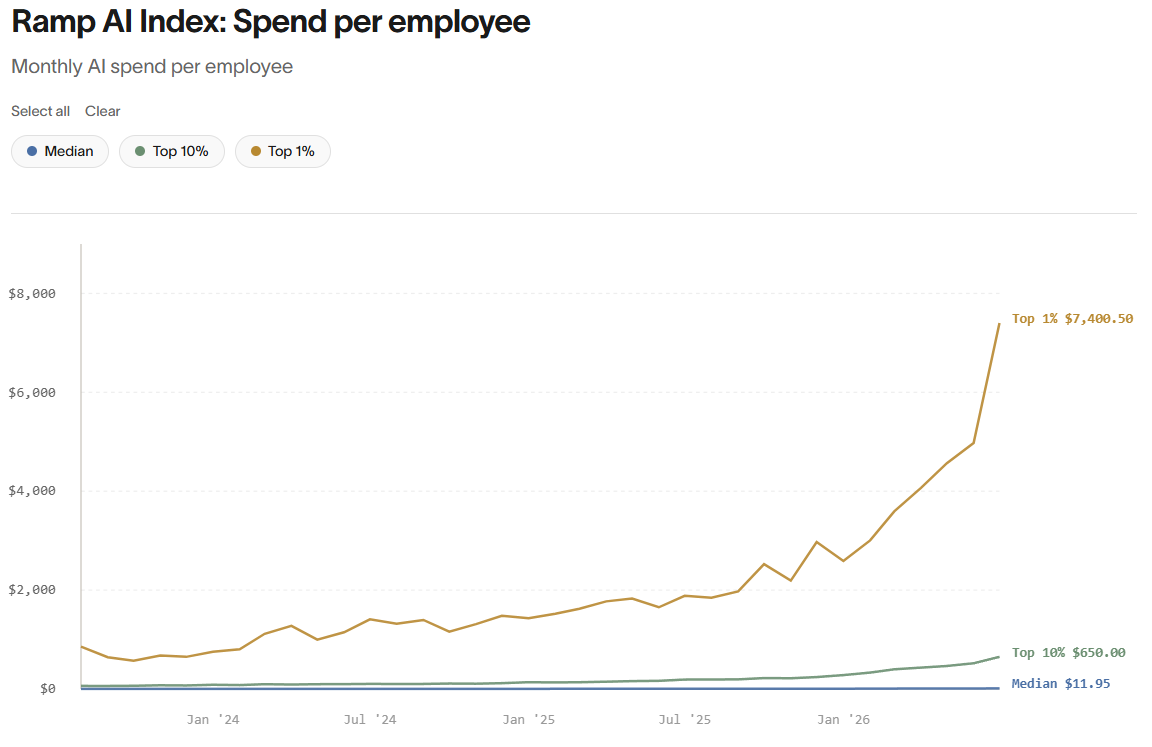 Source: Ramp AI Index, business spend data from Ramp. AI spend includes LLM subscriptions, coding agent subscriptions, API tokens, and GPU cloud and infrastructure spend.
The top 1% of U.S. corporations spend USD7,401 on AI tokens per employee per month, while the median remains low at USD12 per employee per month. However, the momentum changed substantially after the launch of mature harnesses such as Claude Code in 2H 2025.
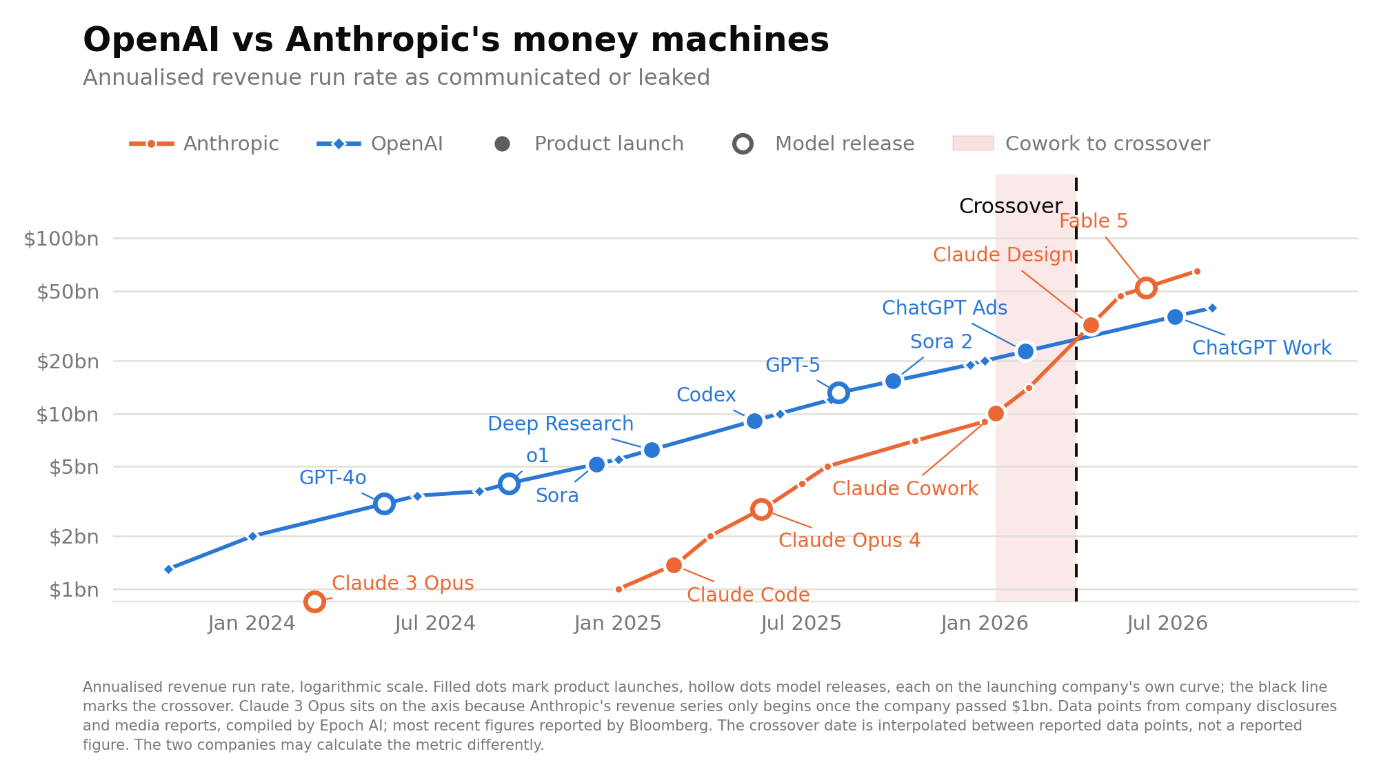
Anthropic’s annualized revenue run-rate hit USD65bn in Aug 2026, up from a USD1.5bn run-rate when Claude Code was first introduced. OpenAI’s run rate stands at USD40bn and it seems Sam Altman is getting desperate.
Anthropic is looking to list in October and it has just reported that it has achieved adjusted operating profit.
5. Hyperscaler’s CAPEX on DC, FCF and inflation
When I first wrote about AI and TSMC back in 2024 (click here for the article), there was no matured AI harness, no Claude code or OpenClaw, it was unthinkable to me that DC Capex could surge so quickly without causing an oversupply.
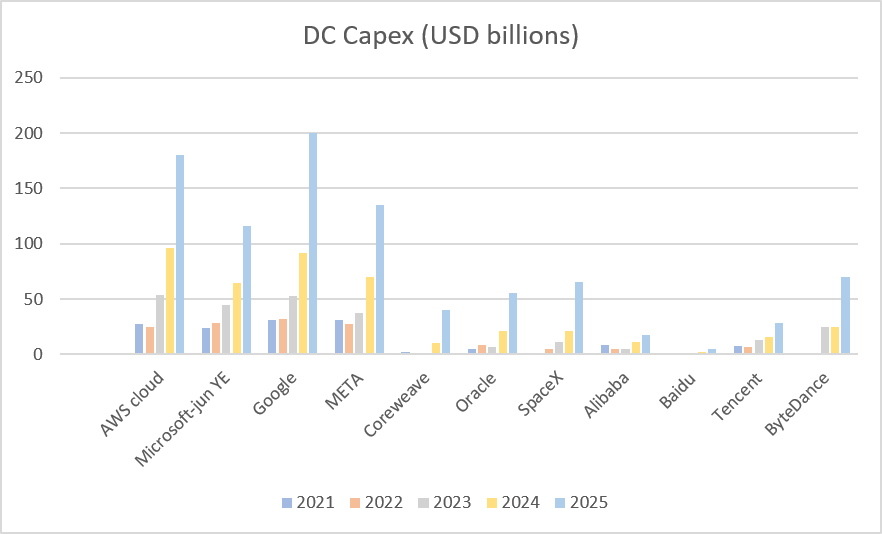 Source: company and OP
DC capex of Top 10 hyperscalers is expected to surge from USD150bn+ in 2022 (Pre-ChatGPT) to over USD900bn in 2026F, a 6x increase in merely 4 years. Industry research forecasts CAPEX to grow further to USD1.3 trillion in 2027 and USD1.5 trillion in 2028.
5.1 Aggregate Hyperscaler’s free cash flow and Net Cash/(Debt)
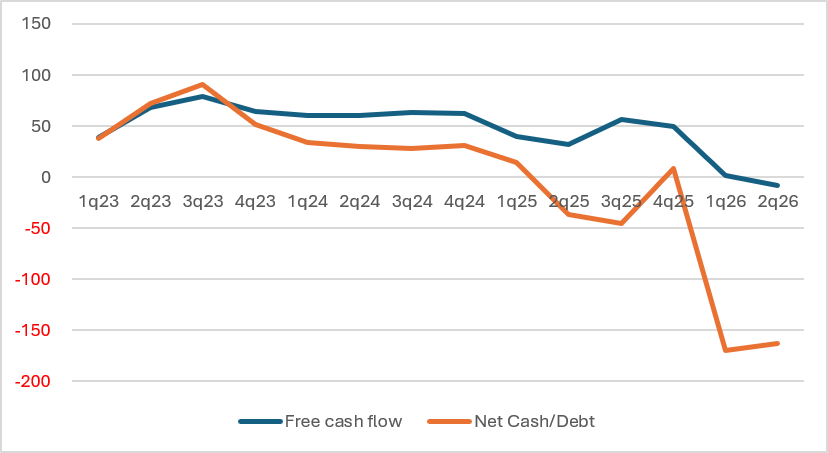
source: company report. This chart represents the aggregates FCF and Net cash/debt of 8 major hyperscalers including Amazon, Microsoft, Google, Meta, Oracle, Coreweave, Baba and Baidu.
The aggregate free cash flow of the 8 hyperscalers went from an inflow of USD65bn per quarter in early 2023 to an outflow of USD9bn in 2Q26. For a long time, these companies sat on huge net cash positions, which have all vanished in recent quarters, with their net debt reaching USD163bn in 2Q26.
Prior to the introduction of matured AI harness in 2h25, I assumed that the DC Capex cycle might peak this year. However, it now looks like the Capex upcycle will be extended for a while. Nevertheless, the piling up of debt and growing negative free cash flow is not sustainable unless the aggregate cash flow generation from AI usage is truly picking up. Frontier AI model companies such as Anthropic, OpenAI, Zhipu and Minimax are all raising prices one way or another; the cost to serve is just too high and they are starting to make consumers face the reality. Even the long-standing cheapest model, DeepSeek, has raised price by over fourfold. As mentioned previously, Anthropic said it has achieved the first ever adjusted operating profit for 2Q2026, though it remains to be seen what “adjusted” means.
5.2 Cost Inflation
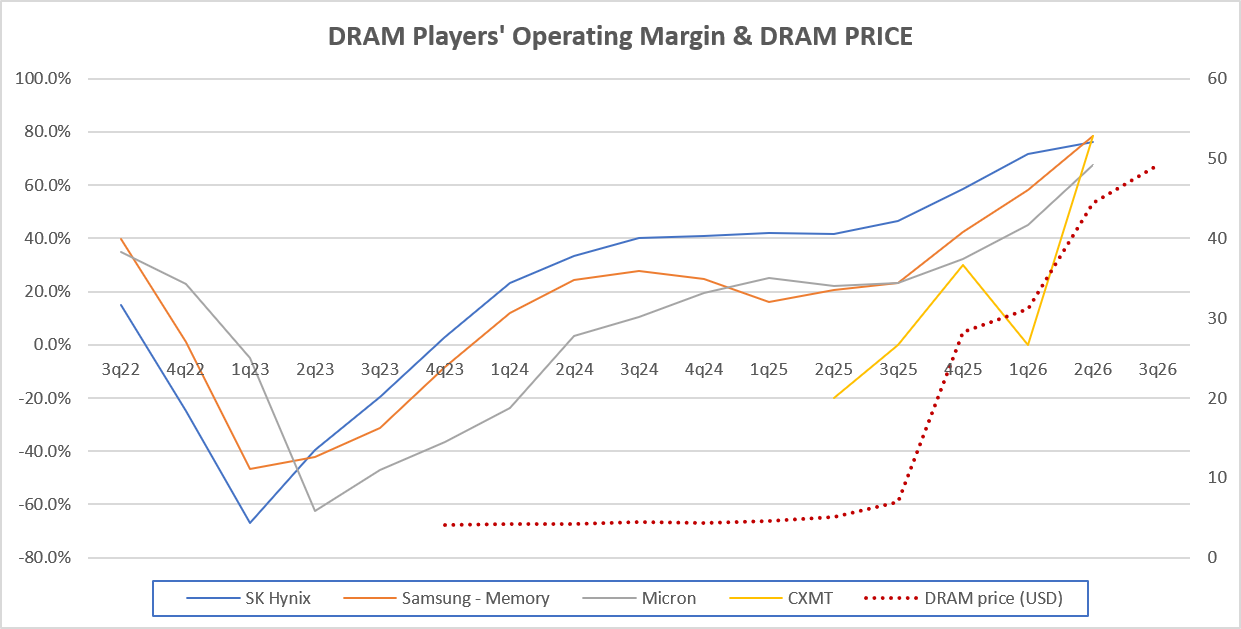 Source: Bloomberg.
The surge in DC Capex within a compressed time frame leads to rising prices across everything: land costs, civil and M&E contractor margins, electricity and water tariffs, turbines, generators and networking equipment, as well as semiconductors. It is well known that DRAM prices have surged through the roof, but their impact on the DC capex cycle is less discussed.
DRAM DDR5 spot prices surged close to 10X, from USD5 to USD50, in the last twelve months due to extreme supply constraints. According to TrendForce, total memory chip (DRAM + NAND) costs will take up 68% of hyperscalers’ CAPEX in 2027, up from merely 10% previously.
This extreme cost inflation forces hyperscalers to cough up a lot more money just to get a similar level of capacity (in terms of MW) built. The urgency to invest to fulfil demand also leads to excesses across the entire supply chain with middlemen profiting handsomely from making deals.
Meanwhile, the top 3 memory makers have massively raised their Capex plans by over 3-fold to bring more supply online from 2027 onwards. Their narrative is that this new supply still would not be sufficient to satisfy demand. Are they standing at the peak of a cycle looking far into the future as shown in the first picture?
6. Power and Grid Capex trend
Data centres are exceptionally power- and water-intensive, yet the infrastructure required to support them often takes significantly longer to develop than the data centres themselves. Planning, permitting and constructing new grid infrastructure can take 5–15 years, compared with just 1–5 years for new renewable generation such as solar PV and wind, 1–3 years for data centres, and 1–2 years for EV charging infrastructure.
As a result, grid capacity is emerging as a critical bottleneck across many regions. Insufficient transmission and distribution capacity is driving increasing congestion and delaying the connection of new electricity generation, storage and large-load projects. Grid connection queues have consequently reached record levels globally.
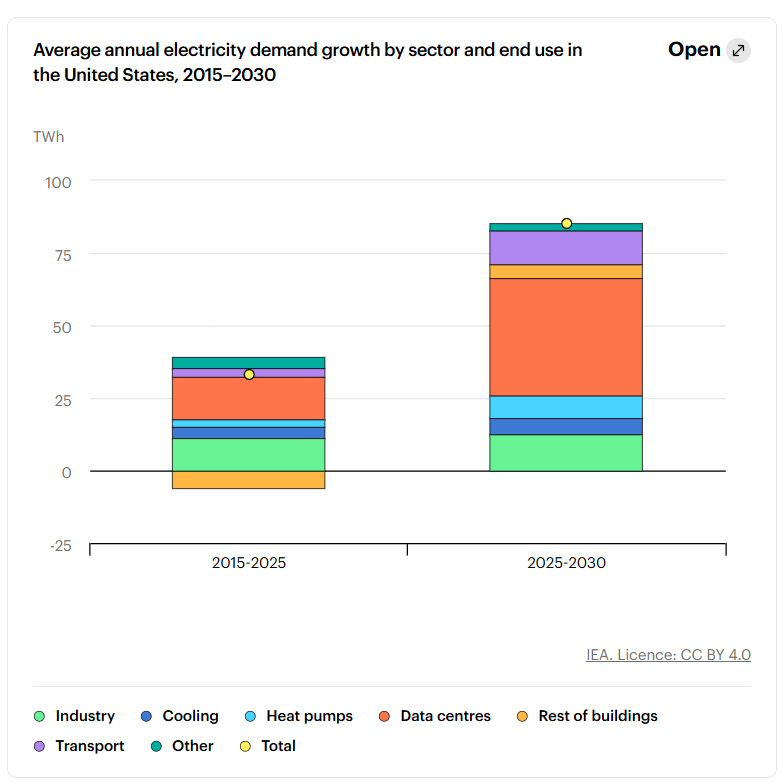 source: IEA
In the US, electricity demand is expected to increase by more than 420 TWh over the next five years, with the rapid expansion of data centres expected to account for approximately 50% of total demand growth through 2030.
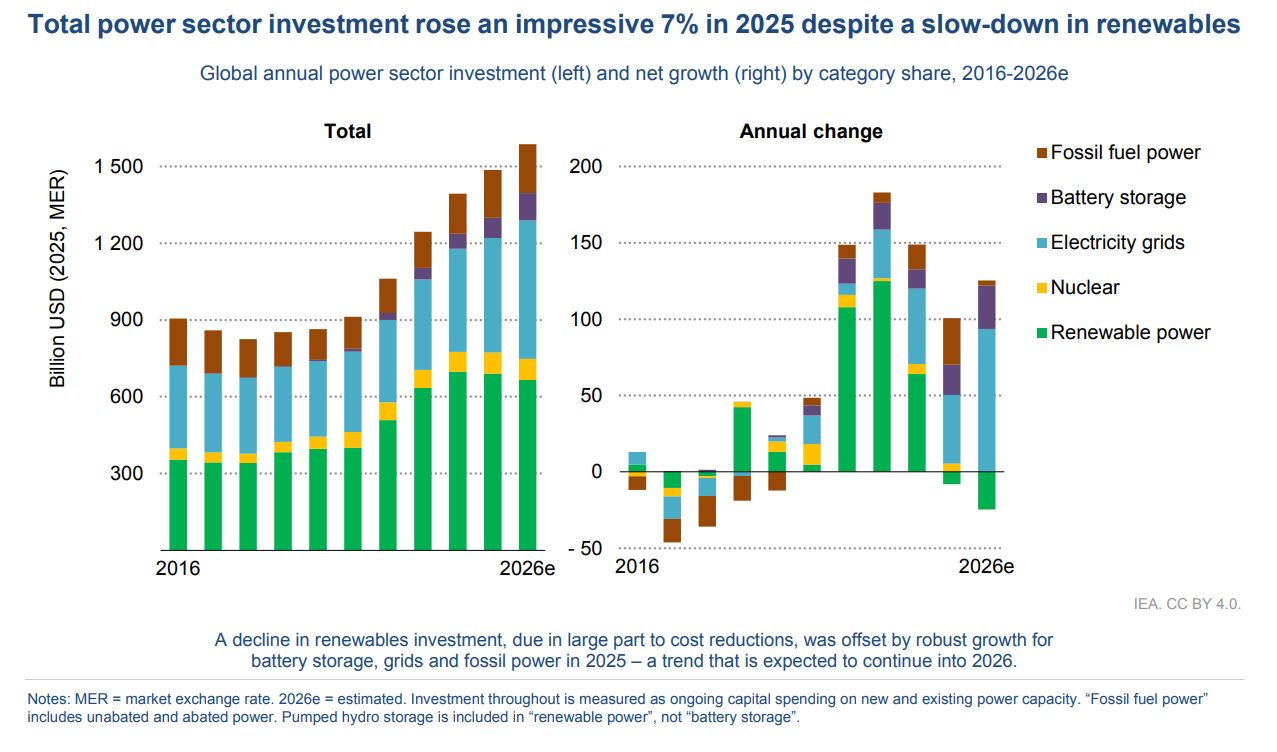 source: IEA
Globally, more than 2,500 GW of renewable generation, large-load and storage projects are currently stalled in grid connection queues. Grid investment has lagged significantly behind investment in new generation capacity, resulting in rising congestion and increasing curtailment in many power systems.
Meeting electricity demand through 2030 will therefore require a substantial acceleration in grid investment. The IEA projects that annual global grid investment needs to increase by approximately 50% from today’s USD 400 billion, alongside expanded grid-equipment supply chains and greater efforts to address workforce constraints.
On top of the above reasons, the world is also going through massive electrification of vehicles. The massive addition of intermittent power generation sources such as solar and wind is also straining grid stability. Regardless of the DC capex cycle, power capex needs to continue for a long time.
Conclusion
It is truly an exciting time to be alive as the world goes through a new industrial revolution. While such a technological shift may render certain business models obsolete and contribute to unemployment in some areas, I believe the way to move forward is as per what Jack Dorsey said in his letter,
“AI collapses the cost of building software, the things that can't be built on demand become the differentiators: judgment, trust, depth of understanding, and capability.”
Humans are pattern-seeking animals, we are all looking for historical lessons from the railway booms in 1800s to the DotCom bubble in 2000s in our attempt to predict how this super capex cycle will evolve — or rather, when the bubble will pop.
Given that AI has enabled myself, a non-programmer, to develop a full-suite portfolio management app (www.1portfolio.org) in 2 days, I think it is truly valuable and almost magical.
The revenues of Anthropic, OpenAI, Zhipu, Minimax and DeepSeek are all growing at triple-digit percentage rates. While it remains far too little to justify the aggregate Capex spend, it does look promising as the adoption rate picks up. On the other hand, there are also real signs of reflexive relationship between equity value of these AI supply chain companies and Capex. The existence of such self-reinforcing relationships is itself evidence of a bubble forming, and things do feel somewhat overheated. When things reverse, it could become a vicious cycle.
At this stage, I cannot say with certainty what will come next as the technology is still evolving, but we are cautious and decided to deploy more into great businesses that are forgotten because they aren’t AI related.
Cycle wise, while there is a risk that the DC and semiconductor Capex cycle might experience a downturn, I think power sector Capex will be more resilient due to underinvestment, electrification of automobiles and AI usage.
Notes and Disclaimers
This essay and the information contained herein is not a specific offer of products or services. Information on this essay is not an offer to buy or sell, or a solicitation of any offer to buy or sell the securities mentioned herein.
Oaklands Path may be long or short the securities mentioned herein and has no duty or obligation to disclose or update our action on these securities.
This essay contains information and views as of the date indicated and such information and views are subject to change without notice. We have no duty or obligation to update the information contained herein. Further, we make no representation, and it should not be assumed, that past investment performance is an indication of future results. Moreover, wherever there is the potential for profit there is also the possibility of loss.
Certain information contained herein concerning economic trends and performance is based on or derived from information provided by independent third-party sources. Although we obtain information contained in our newsletter from sources we believe to be reliable, we cannot guarantee its accuracy. Moreover, independent third-party sources cited in these materials are not making any representations or warranties regarding any information attributed to them and shall have no liability in connection with the use of such information in these materials.